West Highland White Terriers, commonly known as Westies, are a breed of dog known for their distinctive white coat. Originating in Scotland, the breed was used to seek and dig out foxes and badgers.[1] This breed is commonly recognized through its use as a mascot for Black & White (a brand ofScotch whisky), Cesar brand dog food,[2] and various other logos.Commonly, Westies have bright, deep-set eyes that are dark in color. Their ears are small, pointed, and erect.[3] A male typically weighs between 15 and 20 pounds (6.8 and 9.1 kg) and a female between 13 and 16 pounds (5.9 and 7.3 kg). average height is 9 to 11 inches (23 to 28 cm) at the withers.[3] The Kennel Club has recommended that their tails, typically "carrot-shaped", should never be docked;[4] hence the tail should be between 5–6 inches (13–15 cm).[3] They also have deep chests, muscular limbs, a huge skull, a large black nose, a short and a closely fitted jaw with "scissors" bite (lower canines locked in front of upper canines, upper incisors locked over lower incisors).[5] Their teeth generally appear quite large for the size of the dog.[3][5] Westies have a very strong bone structure for their size.[5] They have a soft, dense, thick undercoat and a rough outer coat, about 2 inches long, that requires regular grooming.[3] Some Westies have "wheaten tippings" on their backs, though for individuals put forward for conformation showing this can be regarded as undesirable.[5] Also, some Westies do not have a top coarse coat, and just a second silky coat. This breed is a non-shedding dog. As they develop into adults, their thinner "puppy coat" is normally removed by either 'hand-stripping' or otherwise clipping. 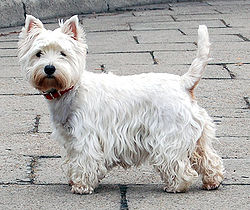 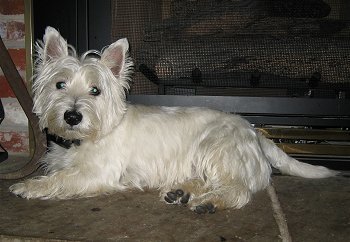 As with most other dogs, Westies generally require around thirteen hours of sleep per day. In order to acquire their needed sleep, Westies will usually follow the sleep patterns of their human companions and also take several naps during the day. The average lifespan of a Westie can range from 12 to 17 years. They also need regular walking.The breed was originally named the Poltalloch terrier, after the estate in the Argyll region of western Scotland where they were developed by Colonel Edward Donald Malcolm (1837–1930) and his family[6]. It is said that the breed gained its white coat after the Colonel's red terrier was mistaken for a fox and shot: the dog was to be white in colour so as to help distinguish it from its quarry. The Westie came to the United States in the early 1900s, originally called Roseneath Terrior. The name was changed to reflect the breed's origins more clearly.[7] Some dog breeders and fanciers also believe that Westies developed with contributions from white dogs in the litters of Cairn Terriers.[7] Others believe that there are contributions from similar dogs developed by the 8th Duke of Argyll (Chieftain of Clan Campbell).[8] [edit]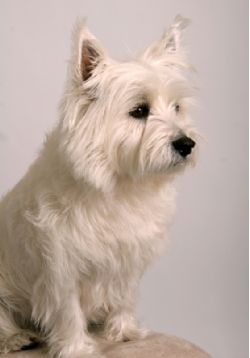 Known to many people as the "Westie," this breed is a small dog but is very well balanced and hardy. Always able to exhibit good showmanship when exhibited, especially when they are groomed properly, they are very elegant looking with a beautiful white coat and bright dark button eyes.
Coat DescriptionThe wiry coat of the little Westie needs brushed about three times a week, or more depending on the lifestyle, with shaping and stripping once every three months. If the West Highland White Terrier is to be shown at a dog show, shaping will be done by stripping, while clipping does the job adequately as pets. 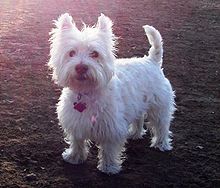 The Westie should be trained to be accustomed to any grooming features as a young puppy before grooming ever begins, beginning with two to three minutes a day to begin with. Daily combings will make him accustomed to being touch all over, and the pleasure of having his coat brushed. The West Highland White Terrier needs firmness when this early training begins, but no roughness or loud voices should be part of the training methods. The next step is to begin the habit of grooming the little Westie about once a week to clip out of place hair and checking his ears, gradually increasing the time spent on the actual grooming. A two to three minute brush-out should begin to be done on a daily basis, laying the Westie puppy on the grooming table until the young dog begins to be anxious about the grooming. The decision whether to strip or groom the little Westie depends a lot on whether or not the dog will be shown or not. Simply put, it is a matter of personal preferences, as stripping makes the coat harder and coarser, while clipping the coat makes it softer and wavy on some dogs. Most people clip a dog because it is easy and quick, and both methods give two entirely different looks to the breed. If the groomers or the owner is good at dog grooming, the standard look of the breed will be as good with a clipper as with stripping. If the decision to use clippers gives too soft of a look, changing the mind is still an option as once the hair is grown back slightly, hand stripping can be done then until it gets the real Westie look and feel, done naturally. 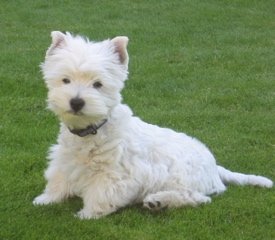 Websites: http://en.wikipedia.org/wiki/West_Highland_Terrier http://www.akc.org/breeds/west_highland_white_terrier/index.cfm |
Exercise for dogs should be the same as exercise for
their owners-it is good for the mind, a good and healthy physical
activity to keep the body in shape, and it relieves stress. Such things
anymore as dog treadmills, doggy day cares, doggie gyms, playing at the
park, or just simple walking-all of these are fun and healthy for the
Westie and its owner. Intelligent as the West
Highland White Terrier is, it is important to understand the whole
concept of the Westie personality and essence of who they are. One
article says it all, "The Westie is really a big dog inside a small
dog's body." The dog has the personality that is spunky, intelligent,
bold, independent, lots of self-esteem--and stubborn. These varied
qualities of the little Westie terrier breed in mind, will help prepare a
person for the beginning "fun of training a Westie." Westie puppies may be affected by craniomandibular osteopathy,
a disease also known "lion jaw". (The disease is an autosomal recessive condition
and so a puppy can only be affected by it if both its parents are
carriers of the faulty gene.) With this disease, the only current
way to identify carrier breeding stock is if an affected puppy is
produced. Therefore, breeders may be unaware that breeding stock are
carriers until an affected puppy is born. Craniomandibular osteopathy is
a non-neoplastic proliferative disease of the ventral mandibular ramus, occipital base
of the skull and tympanic bullae, characterised by excessive bone
deposition in these areas. In most incidences, the defect is bilateral,
although this is not always the case. The disease varies in severity,
the region(s) affected and the individual pain threshold of the affected
puppy. Definitive diagnosis is achieved by radiographicexamination. Craniomandibular
osteopathy is extremely painful to the puppy. Affected puppies will most
likely display signs of pain or discomfort, such as yelping, when their
head is touched and when chewing or eating. The puppy may be lethargic
and be reluctant to eat as a result. The condition usually manifests when the
puppy is around 3–6 months of age, and regresses spontaneously around 12
months of age. Treatment of the disease is concerned with managing the
symptoms and providing appropriate analgesia to improve quality of life
and enable the puppy to eat until the disease resolves spontaneously. Corticosteroids are
the usual therapeutic agents used to manage the disease. The exact
treatment protocol depends on the severity, localisation and pain
sensitivity of the affected puppy. In extreme cases, euthanasia may be required. Originating in the highlands of Scotland, many breeds
have the West Highland White Terrier blood line in them, all
originating back to the early 1800's with each breed deriving their name
from the areas of their origin. These short-legged Scotland terriers
are now known as the Scottish, Skye, Cairn, Dandie Dinmont, and West
Highland White Terriers--and all were bred as small game hunters. Not
raised as pets alone, each breed of terrier was a working dog and had a
specific purpose-keeping vermin in control for the Scotland villages,
coalmines, mills, farms, and homes. Zestful diggers and hunters as they
were, flower gardens and vegetable patches today presents a challenge to
these little hunters. The Westie is a very
intelligent dog who loves human companionship both indoors and
outdoors-but do have issues with other pets or small animals. Introduce
them gradually to the little newcomers, making sure the Westie is not
ignored or pushed back. Happy, curious, and always trying to get into
the middle of everything, they are considered one of the most
affectionate of all the terriers with their also demanding
personality-yet can still feel jealousy if their homeland is
threatened. The West
Highland White Terrier has a few major ones are globoid cell
leukodystrophy, along with Legg
Perthes diseaseand CMO. The Globoid Cell Leukodystrophy disease is
similar to Krabbe's disease in people. A storage disease, it is an
accumulation of galactocerebroside, which is a component of myelin,
leading t o a progressive loss of the myelin. The breeds that are most
affected by the disease are the Cairn and the Westie through an
autosomal recessive disorder. Westies are prone to allergies and dry skin
problems, and bathing too frequently may aggravate these problems.
Washing once a month or on a longer interval will generally not cause
problems. However, frequent brushings are needed to keep the coat clean
and oils evenly distributed throughout the coat. Washing with a
detergent-free, baby-oriented, or another soft skin shampoo will help
keep a Westie's skin hydrated. Weekly washing of the inside of the ears
with cotton balls will prevent oil and wax build-up and ear infections.
Water in the ears must be removed before an infection develops. Westies
should be groomed at least every 6 weeks, and bathed and brushed as
needed between appointments. Westies love dog treats which
can be helpful for dogs to have positive habits. Westie particularly
love dog treats made from beef, chicken, lamb and rice such as Bully
Sticks, Greenies, Dog Beef Jerky, Chicken Dog Treats, Lamb Treats...etc.
You can purchase those dog treats at a local pet retailer such as Petco
or an online dog treat shop such as Gibdog Pet Supplies. Westies are
very sensitive, so make sure to give the right dog treats. Dog treats
for Westies should always be the "big" ones so that it takes a long time
to get a small piece in their mouth. A Westie can get small pieces
stuck in their throat and the raw hide can wear a hole through the
esophagus. The chews become soft and can also get stuck in the roof of
the mouth. Dog treats such as pig ears and raw hides are not good for
Westies. |

